
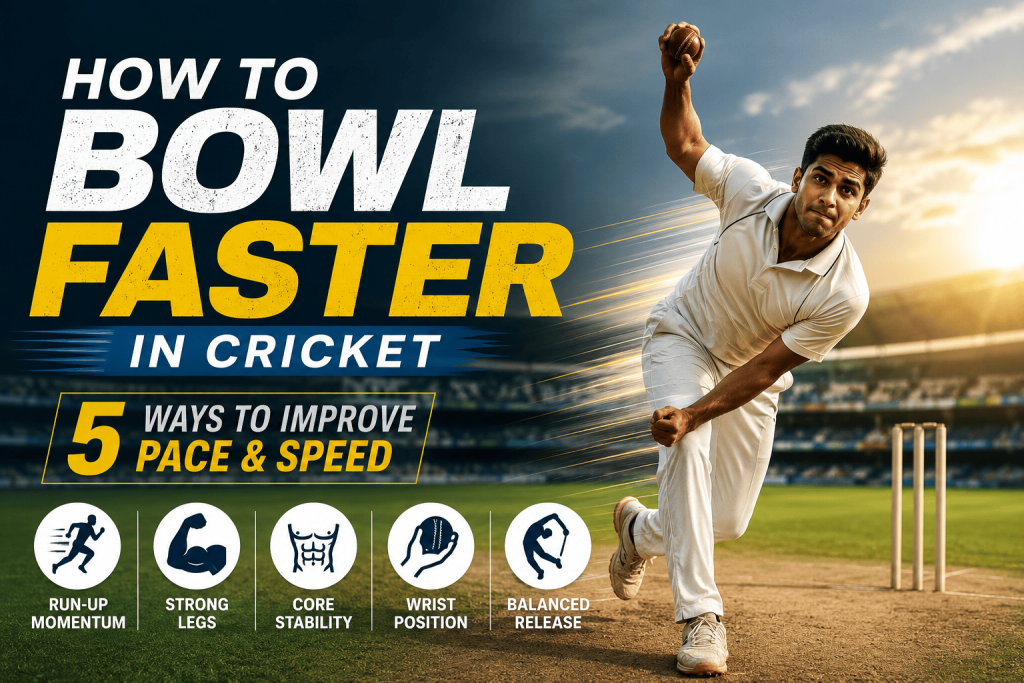
Every young fast bowler wants to bowl quicker and become a more effective wicket-taker. Learning how to bowl faster in cricket isn’t about using more force; it’s about improving your technique, body mechanics, strength, and momentum. Even small improvements in your run-up, balance, and bowling action can help you increase bowling speed while maintaining accuracy and control.
Key Takeaways
If you’re still mastering the basics, start with our guide on fast bowling techniques for young cricketers before focusing on generating extra pace.
Bowling speed refers to the velocity at which a fast bowler delivers the cricket ball. While many players believe pace comes primarily from arm strength, sports science shows that bowling velocity depends on how efficiently the entire body works together.
Fast bowling relies on a sequence of movements known as the “kinetic chain,” where energy travels from the ground through the legs, hips, core, shoulders, arm, and finally into the ball. Better coordination throughout this chain results in greater release speed with less physical effort.
In simple terms, the faster and more efficiently your body transfers energy, the quicker you’ll bowl.
Many players assume arm strength creates fast bowling speed. In reality, bowling speed comes from how efficiently your body transfers energy through the bowling action. Three key factors affect bowling speed:
Factor | Impact on Bowling Speed |
Run-Up Momentum | High |
Leg Strength | High |
Core Stability | Medium |
Wrist Position | Medium |
Balance at Release | High |
Research on fast bowling mechanics has consistently shown that momentum generated during the run-up, explosive lower-body strength, and efficient energy transfer are among the biggest contributors to bowling velocity.
Coach’s Tip: Most young bowlers don’t need to “try harder” to bowl faster. Improving rhythm, timing, and body alignment often adds more pace than simply increasing effort.
Many young bowlers make the mistake of sprinting from the very first step. This often disrupts balance, reduces control, and limits the amount of momentum transferred into the ball. Instead, focus on:
A controlled run-up allows your body to move efficiently into the delivery stride, improving both bowling speed and consistency.


Your legs are the biggest source of power in fast bowling. Every powerful delivery starts with force generated from the ground.
When your lower body is strong, you can:
Strong leg muscles also reduce fatigue during longer spells, helping you maintain your pace throughout an innings. Exercises such as squats, lunges, split squats, and step-ups improve strength while supporting better bowling mechanics.
Remember, bowling faster isn’t just about stronger muscles, it’s about using those muscles efficiently.
A stable core allows energy generated by your legs to transfer smoothly through your torso into your bowling arm. Without this connection, power is lost before the ball leaves your hand. Benefits of good core stability include:
Many young cricketers focus only on upper-body strength while neglecting their core. Regular planks, dead bugs, Russian twists, and medicine ball throws can significantly improve bowling efficiency.


Keeping your wrist directly behind the ball at release helps transfer more energy into the delivery while producing better control. To improve your wrist position:
• Keep the wrist firm throughout release
• Position it behind the ball
• Maintain an upright seam
• Avoid allowing the wrist to collapse sideways
Many professional fast bowlers spend considerable time strengthening their wrists because even small improvements can positively affect bowling velocity.
Many young bowlers lose speed because they lean excessively towards the off side or fall away immediately after releasing the ball. This causes energy to move sideways instead of directly towards the batter.
Good balance allows you to:
Keep your head above your front foot, stay aligned towards your target, and complete a controlled follow-through after every delivery.


Exercise | How It Helps | Coaching Tip |
Sprint Training | Builds acceleration and run-up momentum for faster bowling speed. | Sprint 20–40 m with full recovery between runs. |
Squat Variations | Strengthens the legs to generate more bowling power. | Include front squats, goblet squats, or split squats 2–3 times a week. |
Box Jumps | Improves explosive leg power and athletic performance. | Prioritise explosive take-offs and soft landings. |
Medicine Ball Throws | Develops hip rotation and power transfer through the bowling action. | Perform rotational throws to replicate bowling movement. |
Plank Variations | Builds core strength, balance, and bowling stability. | Combine front, side, and dynamic planks for better core control. |
Training Tip: Combine these exercises with regular fast bowling drills for beginners to improve bowling speed, rhythm, accuracy, and consistency.
Common Mistake | Impact on Bowling Speed | How to Fix It |
Rushing the Run-Up | Reduces rhythm and momentum. | Build speed gradually with a smooth run-up. |
Overstriding | Reduces power and energy transfer. | Maintain a comfortable delivery stride. |
Falling Away | Lowers pace and accuracy. | Stay balanced and keep your head over the front foot. |
Weak Leg Strength | Limits power and front-leg drive. | Build leg strength with squats and lunges. |
Poor Fitness | Causes fatigue and inconsistent pace. | Improve strength, mobility, and endurance. |
Coach’s Tip: Fast bowlers generate pace through efficient technique and fitness, not just effort. A balanced bowling action and strong lower body will consistently produce better speed than trying to bowl harder

Learning how to bowl faster in cricket takes consistent practice and proper technique. A smooth run-up, strong legs, stable core, firm wrist position, and balanced release all help increase bowling speed while maintaining accuracy. Check out these 5 Fast Bowling drills for beginners to improve pace and accuracy during your trainings.
Focus on improving one skill at a time, track your progress, and continue practicing regularly. As you develop more pace, follow our injury prevention tips for fast bowlers to stay fit and keep improving safely.
How can I bowl faster in cricket?
Improve your run-up rhythm, strengthen your legs and core, maintain a firm wrist position, and stay balanced throughout your bowling action. Better technique helps you bowl faster in cricket than simply bowling harder.
What exercises increase bowling speed?
Sprint training, squats, lunges, box jumps, medicine ball throws, and core exercises are among the best exercises to increase bowling speed.
Does gym training help fast bowlers?
Yes. Strength training improves lower-body power, stability, and bowling speed when combined with regular bowling practice.
How can I increase bowling speed without losing accuracy?
Improve your technique, balance, and bowling mechanics. A smooth run-up, stable core, and strong wrist position help increase bowling speed without sacrificing accuracy.
What is a good bowling speed for a 14-year-old fast bowler?
Most developing fast bowlers aged 14 bowl between 95–115 km/h. However, improving bowling mechanics, accuracy, and consistency is more important than chasing pace.
Can teenagers naturally increase bowling speed?
Yes. Teenagers can naturally increase bowling speed through proper coaching, strength training, sprint work, mobility exercises, and consistent practice.
REPL Sports,
Paarth Republic Township,
Lucknow-Kanpur Road,
Sarojini Nagar, Lucknow -226008
REPL Sports,
820, Antriksh Bhawan, 22 KG Marg,
Connaught Place, New Delhi – 110001