

Most beginners step to the crease wanting to hit sixes. That’s the problem.
Great batting is not about muscle; it’s about method. Before you score runs consistently, you need a foundation: a correct grip, a solid stance, sharp footwork, and smart timing.
These cricket batting tips for beginners won’t just help you look good in the nets. These practical techniques help young players build confidence, improve timing, and develop strong cricket batting skills that transfer directly into match situations.
They’ll help you survive longer, score smarter, and build habits that transfer to real match situations. Building correct technique from the start is everything; read about the Best Age to start cricket coaching so you know exactly when to begin structured training.
Strong batting starts with fundamentals. Master your grip, stance, footwork, and timing before focusing on power.
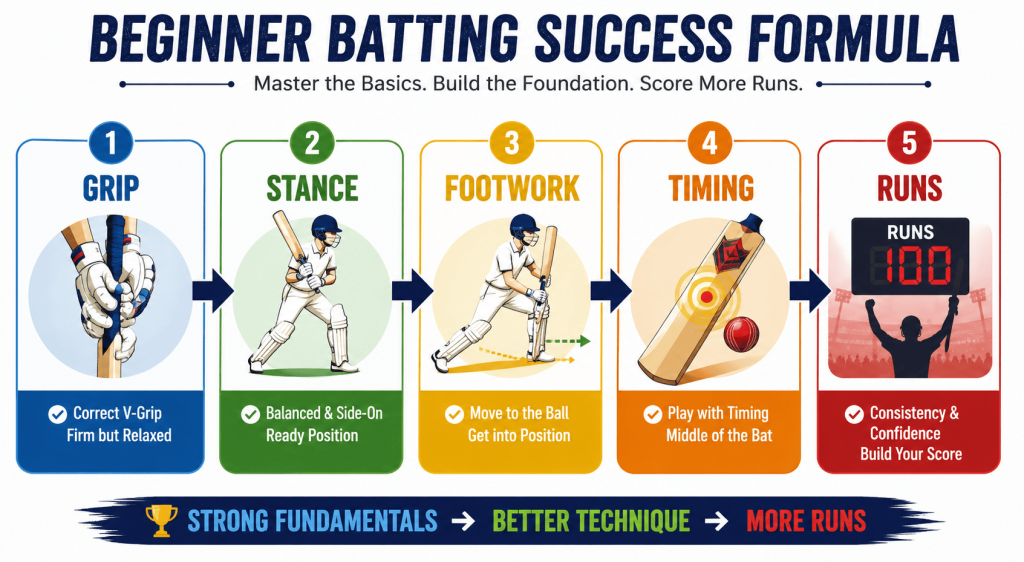
Developing the correct batting technique in cricket is far more important than hitting boundaries early. A solid cricket batting technique helps players stay balanced, make better decisions, and score consistently under pressure.
Self-practice builds repetition, but the Benefits of Professional Cricket Coaching include real-time feedback and technique correction that no mirror can give you.

Every great batter starts with two fundamentals: a correct cricket batting grip and a balanced cricket batting stance. Together, they create the foundation for good timing, footwork, and shot control.
Both thumbs and index fingers should form a “V” shape pointing down the back of the bat handle.


A strong cricket batting stance allows you to react quickly and stay balanced against every delivery.
The Correct Cricket Batting Stance
The moment your head falls away from the ball, balance and timing become difficult.
A strong stance also depends on mobility and balance. Pair your training with our Complete Fitness Guide for Young Cricketers to improve lower-body stability and athletic movement.
Coaches often consider footwork the most important part of a successful cricket batting technique because it determines balance, timing, and shot execution.
Two footwork rules every beginner must own:
The most common beginner error is planting both feet and reaching for the ball. That reaching motion is where edges and miscues come from every time.
Beginner Drill, Shadow Batting: No ball needed. Stand in your stance and practice front-foot and back-foot movements for 10 minutes daily. Muscle memory from shadow batting transfers directly into live net sessions.
Understanding what pace bowlers are trying to do sharpens every footwork decision you make. Read Fast Bowling Techniques for Young Cricketers to build that reading skill early.
One of the most valuable cricket batting tips for beginners is learning to watch the ball closely and play it as late as possible.
Track the ball from the bowler’s hand all the way to the bat. This helps you pick up the line, length, and movement early, giving you more time to react. The sooner you recognize the delivery, the better your decision-making becomes.
Playing the ball late means allowing it to come closer to your body before making contact. This simple adjustment is a key part of good batting technique in cricket because it improves control and reduces the chance of edging the ball to fielders.
Many coaches consider this one of the most important cricket batting skills for young players because it builds consistency against all types of bowling.
Coaching Tip
Instead of reaching for the ball, let it come to you. The later you play it under control, the easier it becomes to place your shots and build an innings.
One reason these cricket batting tips for beginners work so well is that they prioritize timing before power, helping players build long-term consistency.
When you overhit, your head drops and your shape collapses. The ball that could have been timed for a boundary instead finds the fielder or your stumps.
Clean timing through a correct swing arc generates all the power you need. Bat speed follows good mechanics; it is not a product of brute strength.
Practice Rule: Hit at 70% power in every net session. Feel the timing first. Power arrives naturally when your technique is right.

These simple cricket batting shot tips help beginners understand when to attack, when to defend, and how to choose the right shot for each delivery.
Cricket Shot | When to Play | Key Focus |
Forward Defence | Full, straight deliveries | Protect your wicket with a straight bat and solid balance. |
Straight Drive | Full balls on the stumps | Drive straight down the ground with good timing. |
Cover Drive | Full balls outside off stump | Step forward and time the ball through the covers. |
Pull Shot | Short-pitched deliveries | Move onto the back foot and play toward the leg side. |
Following these cricket batting shot tips regularly will improve shot selection and confidence at the crease.
Practice is what turns technique into habit. Instead of simply hitting balls in the nets, focus on drills that improve specific aspects of your game.
These exercises develop essential cricket batting skills such as timing, balance, hand-eye coordination, and footwork. Alongside batting practice, work on Best Cricket Fielding Drills for Beginners to become a more complete cricketer.
Drill | Purpose |
Shadow Batting | Improves footwork, balance, and movement patterns. |
Tennis Ball Wall Drill | Develops hand-eye coordination and reaction time. |
Hanging Ball Drill | Improves timing and bat control. |
Cone Checkpoint Drill | Builds a consistent swing path and shot accuracy. |
How Often You Practice | What You Can Expect |
1–2 times a week | Slow but steady improvement. |
3–4 times a week | Better timing, footwork, and shot control. |
4–5 times a week | Faster skill development and greater confidence. |
Daily (structured practice) | The quickest route to noticeable improvement. |
One of the simplest cricket batting tricks used by coaches is to focus on correcting one mistake at a time instead of trying to fix everything in a single session.
Cricket Batting Trick: Fix one mistake per session, not all five at once. Focused correction builds better technique than scattered attention ever will.
Every professional batter started exactly where you are today. These cricket batting tips for beginners focus on the same fundamentals that coaches teach at every level of the game. The key is building strong cricket batting skills through repetition, patience, and deliberate practice.
As your cricket batting technique improves, timing becomes easier, confidence grows, and scoring runs becomes more natural.
When you are ready for real feedback and structured development, explore the Benefits of Professional Cricket Coaching and start building technique that holds up when the match is truly on the line.
Stand side-on with feet shoulder-width apart and knees slightly bent. Weight should be balanced equally on both feet. Head still, eyes level, front shoulder pointing at the bowler. A correct cricket batting stance allows you to move quickly forward or back without losing balance on any delivery.
Use shadow batting daily to build footwork habits. Record yourself from front-on and side-on angles to spot technique errors. Use a hanging ball or tennis wall drill to sharpen timing. Watching professional batters in slow motion and comparing your own movement builds self-awareness faster than generic practice alone.
Learn the forward defensive shot first. It is the foundation of every attacking shot in cricket and teaches correct head position, footwork, and bat-face control simultaneously. Once your forward defense is consistent, move to the straight drive, then the cover drive, then the pull shot.
Play with soft hands and a balanced stance. Do not swing hard; let the pace come to the bat. Pick up the ball early from the bowler’s hand and use your back foot to create space for short deliveries. For a complete breakdown, read Fast Bowling Techniques for Young Cricketers.
Use your feet to get to the pitch of the delivery. A still head and decisive footwork are the two keys against spin. Reading the bowler’s action before release gives you extra time to position correctly. Build that skill with our Spin Bowling Fundamentals for Beginners guide.
Most coaches recommend starting structured coaching between ages 7 and 10, when motor skills and concentration develop most rapidly. Early coaching builds correct habits before bad technique becomes ingrained. Read our full guide on the Best Age to Start Cricket Coaching for a detailed breakdown.
REPL Sports,
Paarth Republic Township,
Lucknow-Kanpur Road,
Sarojini Nagar, Lucknow -226008
REPL Sports,
820, Antriksh Bhawan, 22 KG Marg,
Connaught Place, New Delhi – 110001